
STRIAE
DISTENSAE
MEDICAL MICRONEEDLING
Treating stretch marks with EXCEED and EXCEED UNLIMITED: assess the stage, plan a documented series and evaluate progressive changes in skin texture and scar quality.


Clinically Proven
Explore clinical evidence

German Engineering
Built to exceptional standards

10-Year Full Warranty
Long-term investment protection

ISO 13485-Certified
quality management system
Early striae at 6 months
Across randomized evidence
Documented by biopsy
Exceed striae study

Medical Microneedling for Striae Distensae
Treatment techniques, needle depth, clinical endpoints and post-treatment care.
See the treatment in practice
Watch PD Dr. med. Matthias Aust demonstrate medical microneedling for abdominal stretch marks. This expert demonstration presents an individual technique; the research methods and outcomes below are drawn separately from Kampmann et al. [1].
How do you optimize the technique?
Explore needle depth adjustments, skin stretching, circular movements and device settings for treating striae.
What indicates the treatment endpoint?
See how visible tissue elevation and pinpoint bruising help identify when sufficient treatment has been achieved.
Why is proper aftercare essential?
Learn how post-treatment cleansing, skin care and crust prevention support the healing process.
Complete the form to watch the expert video.
From striae assessment to documented improvement.


A structured pathway for body striae
The EXCEED family offers medical mechanical microneedling. This study provides exploratory evidence for improving the texture and quality of stretch-marked skin.
Eight adults were analysed from 22 enrolled: seven women and one man, aged 18–64 years, Fitzpatrick I–IV. Four had lower-abdominal striae and four had hip or thigh striae. The research used the original EXCEED model.
Research schedule
Study population
What this evidence can establish
The study compared treated striae with healthy reference skin, not untreated striae. Attrition, variable visit schedules and the small sample limit causal interpretation and generalisation. Results were not stratified into validated protocols by stage, cause or body site. Photographs shown here are illustrative cases from the existing website, not verified study participants.
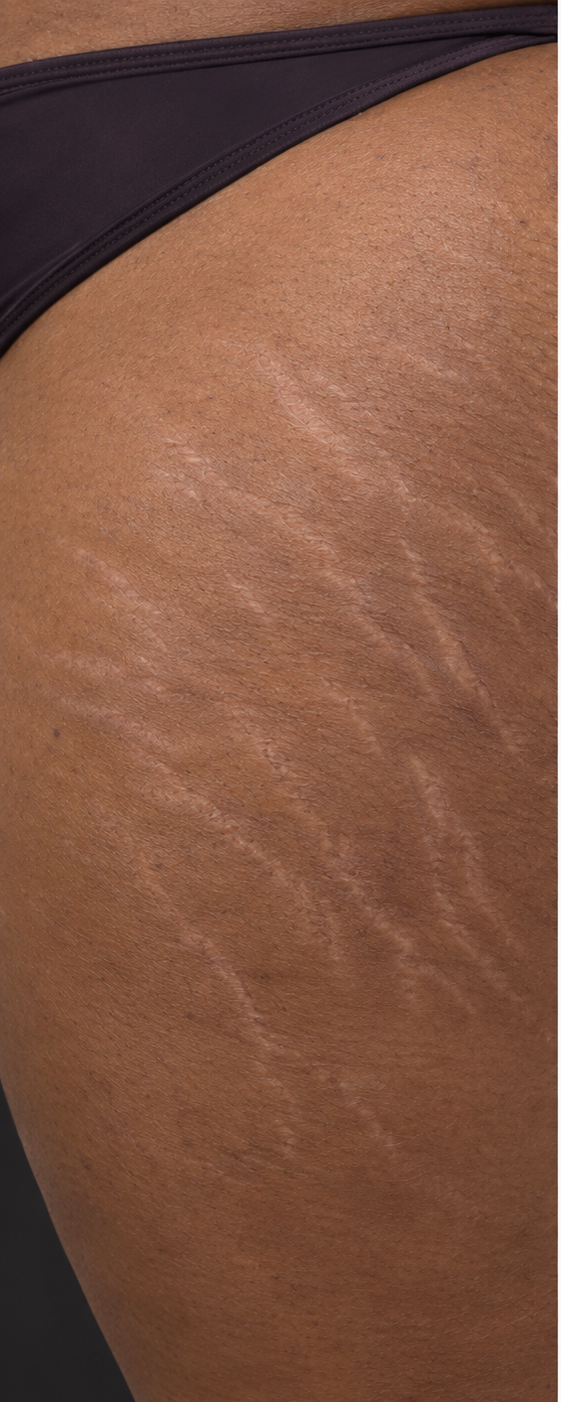
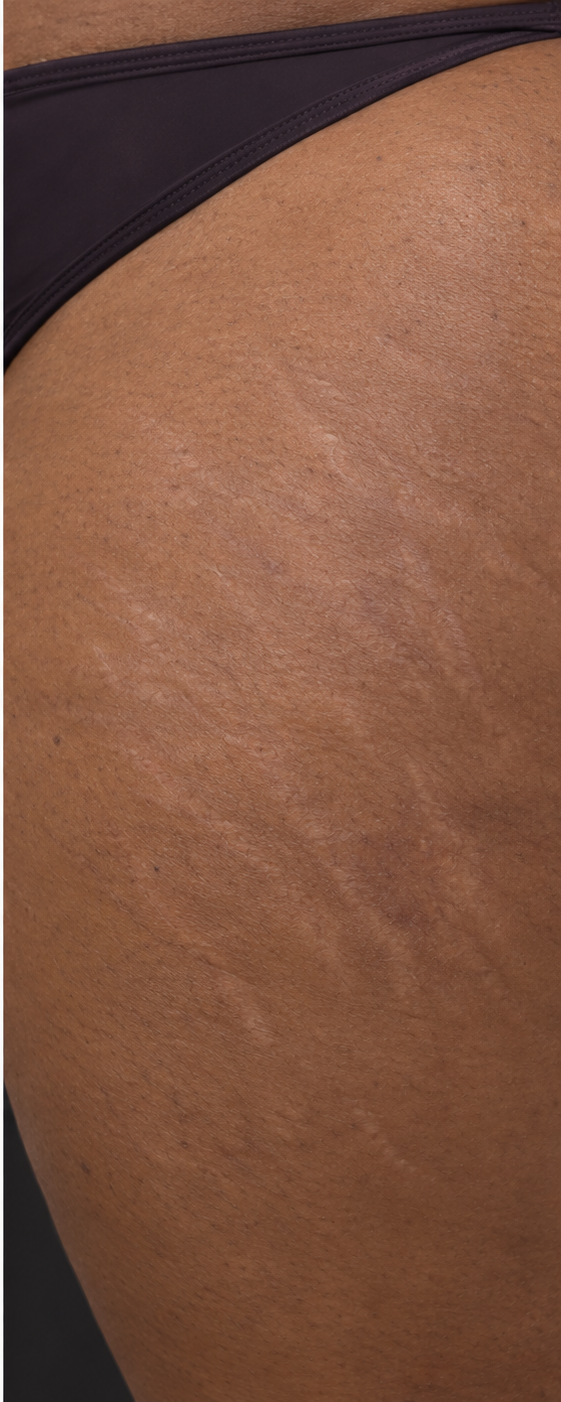
Illustrative cases: Dr. Zoya Evsyukova (first pair) and amiea med (second pair). Session counts and follow-up dates are not supplied for these images.
Assess. Plan. Treat. Document.
Distinguish rubrae from albae
Assess appearance and duration together before planning a series.
Rubrae represent the early erythematous, sometimes raised stage; albae are later, pale and atrophic. The study included acute striae less than one year old and chronic striae more than one year old, but excluded lesions younger than six months.
How stage changes the discussion
For the study population, the acute window was approximately 6 to less than 12 months. Discuss texture and scar-quality improvement for both stages. The paper does not establish separate depths, pass counts or success rates for rubrae versus albae.
Define the evidence-supported patient profile
Record age, sex, BMI, Fitzpatrick skin type and the location of the striae.
Participants were adults aged 18–64 years with Fitzpatrick I–IV. Treated sites were the lower abdomen, hips and thighs. Skin tumours or precancerous lesions, acute skin disease, recent UV exposure in the area and microneedling for striae within six months were exclusion criteria.
Cause and anatomical limits
The paper discusses stretching associated with pregnancy, weight change and puberty, and endocrine causes such as Cushing’s syndrome. It does not provide cause-specific treatment algorithms or prove equal efficacy across all body sites or phototypes. Its eligibility criteria are not an exhaustive clinical contraindication checklist.
Return to the same lesions at every visit
Reproducible positioning makes longitudinal assessment meaningful.
The investigators created an individual template matching each participant’s striae pattern and marked the treatment and measurement points before each session. Healthy contralateral skin provided a reference for objective measurements.
What to document
Record the same striae and control points at baseline and subsequent visits. The study used high-resolution photographs and Visioscan imaging before the first treatment, after treatments and at follow-up. Healthy reference skin represents a comparison target, not an untreated-striae control.
Prepare for a controlled procedure
The published preparation included 30 minutes of topical anaesthesia.
The investigators removed the anaesthetic with water-soaked gauze, then degreased and prepared the skin with alcohol immediately before needling. This describes the study method rather than a universal anaesthetic or antisepsis prescription.
Published formulation and limits
The methods specify lidocaine 23% / tetracaine 7% gel. This high-strength research formulation should not be adopted as a routine recommendation from this page; anaesthetic choice and exposure require professional assessment and applicable product instructions.
Plan monthly sessions and reassessment
The study scheduled up to four sessions across approximately 60–90 days.
Medical mechanical microneedling was the intervention analysed; no additional therapeutic modality was included. Visits varied between participants, and only three reached the fourth measurement visit. The six-needle tilting plate is described in the research device.
Depth, passes and endpoints: what is actually reported
The paper describes the research pen’s range as 0.1–2 mm but does not report individual treatment depths, frequency, number of passes or stage-specific endpoints. That range must not override current model instructions: the EU product page specifies a 1.5 mm maximum for EXCEED UNLIMITED. The video’s technique is not a protocol validated by this study.
Plan post-procedure care
Preventing scabbing was the stated aftercare objective.
The methods report applying ENVIRON Body EssentiA Vitamin A, C and E Body Oil after treatment to prevent scabbing. They do not provide a detailed home-care timetable or a validated comparison of aftercare products.
Interpret the report carefully
The conclusion states that no personal-care products were used, which conflicts with the aftercare described in Methods. The product named here is a report of the method, not an endorsement for use after every device or procedure. Use the applicable IFU and clinical assessment for actual care.
Combine photographs, probes and scar scores
Assess the same sites before each session and again after the series.
Visioscan assessed surface structure, smoothness and wrinkle-like relief. Additional probes measured barrier function, pigmentation, hydration, firmness and elasticity. POSAS captured patient and observer perspectives; NRS was used for pain assessment.
Timing and patient conversation
The methods specify baseline and three-month post-treatment questionnaires, while the results also present scores across treatment visits. Keep the assessment date and time since treatment explicit. Ask about appearance, texture, discomfort and the patient’s own perception of change rather than assuming that satisfaction equals scar clearance.
Look for progressive structural improvement
The authors reported time-dependent changes, with a clearer signal from around Day 60.
At Day 0 versus Day 90, the modelled mean difference from healthy reference skin narrowed from 71% to 17% for anisotropy, 44% to 22% for SEsm smoothness and 52% to 30% for SEw wrinkle-like relief. These are differences from reference skin, not percentages of stretch-mark removal.
Read the numbers with their uncertainty
Day-90 95% confidence intervals were wide: −39% to 72% for anisotropy, −44% to 88% for SEsm and −24% to 84% for SEw. Roughness and scaliness did not show consistent significant change. The study describes exploratory trends in eight participants, not guaranteed outcomes.
Discuss improvement, not disappearance
Scar-quality scores improved, but individual responses varied.
The authors report mean observer POSAS scores of 39.50 → 24.67 and patient scores of 32.00 → 22.67 (both p < 0.05). Pigmentation ratings, relief and overall impression were among the strongest reported changes. Satisfaction was reported as 87.5%.
Set realistic expectations
Lower POSAS scores indicate better scar quality. Subjective pigmentation ratings do not establish objective repigmentation; the discussion reports no pigmentation change. There is no robust estimate of complete clearance, long-term durability or superiority by cause, stage or anatomical site.
The publication behind this pathway
Clinical planning, methods and outcomes in this pathway are based on Kampmann et al. [1].
[1] Kampmann A, Bender R, Busch K, Bauer C, Hettwer K, Aust M. Medical microneedling for the treatment of striae distensae. A prospective study using the exceed Medical Needling Pen. Aesthetic Medicine. 2026;12(2):18363. doi:10.57662/AM.2026.18363.
Study limitations and family attribution
This prospective case series used the original EXCEED Medical Needling Pen, not a direct comparison of EXCEED-family models. Eight of 22 participants were analysed after loss to follow-up. There was no untreated-striae comparator, and the report contains inconsistencies in visit timing and aftercare. The findings support further research and careful outcome documentation, not a fully specified universal protocol.
Visible changes in texture and striae definition.
Illustrative individual case. Courtesy of Dr. Zoya Evsyukova. Treatment count and follow-up interval are not supplied; not a verified Kampmann study case.
Visibly Reduced Stretch Marks and Smoother, More Even-Looking Skin
These before-and-after photographs show the upper thigh area following medical mechanical microneedling for stretch marks (striae distensae). In the after image, stretch marks appear significantly less visible, with a smoother and more uniform skin texture. Individual results may vary depending on skin condition and treatment response.


Illustrative individual case. Courtesy of amiea med. Treatment count and follow-up interval are not supplied; not a verified Kampmann study case.
Visibly Reduced Stretch Marks and Smoother Skin on the Buttocks
These before-and-after photographs show the buttock and upper thigh area following medical mechanical microneedling for stretch marks (striae distensae). In the after image, stretch marks appear less prominent, with smoother, more even-looking skin texture. Individual results may vary depending on skin condition and treatment response.
Control that matters for body microneedling.

Contact across body contours
The contour-adaptive plate supports controlled entry and withdrawal. For curved areas such as hips and thighs, maintaining contact is a practical design consideration.

Stable six-needle delivery
High-frequency movement and six-needle geometry support controlled mechanical penetration. These design features are relevant to consistent coverage.

A fresh sterile cartridge
Sterile, single-use cartridges support a hygienic workflow. This supports the procedural rationale comparison of infection rates.

Protection for the handpiece
The safety membrane and protective sleeve help protect against fluid ingress and external contamination. This product-design benefit complements the sterile cartridge; it does not replace cleaning or the current instructions for use.

Model-specific depth control
Adjustable penetration supports deliberate treatment settings. EXCEED UNLIMITED has a stated 1.5 mm maximum with a default cartridge.

Mechanical action without RF heat
The EXCEED family uses mechanical needling. Alster and Li’s body-striae series identifies the absence of thermal injury as relevant to nonfacial sites and darker skin [2].
Bring a documented approach to your practice.
Explore the EXCEED family, product information and professional training. Discuss device options and clinical education with a product specialist.
